ニュース
Suprema の最新プレスリリース
How Cloud Access Control Became the Digital Backbone of Modern Buildings
December 12, 2025

Digital transformation of security is no longer a trend but a reality. One of the clearest signs of this change is the rapid shift from traditional, on‑premises access control systems to cloud‑based models known as ACaaS (Access Control as a Service). This concept is reshaping how identities, entry points, access rights, and security policies are managed today.

The move to real‑time, remote security management is driven not only by technology. It is equally the result of economic, operational, security, and regulatory factors—from reducing maintenance costs and speeding up user administration to meeting new European requirements such as the NIS2 Directive and the Cyber Resilience Act.

At a time when the access control market is valued at more than 10 billion dollars and growing rapidly at 8.3% annually (MarketsandMarkets), and when cloud and mobile technologies dominate next‑generation projects, a key question arises: is ACaaS merely a modern upgrade to existing systems, or does it represent a fundamental shift in how facilities are secured?

This article therefore examines the key technical, business, and market aspects of this technology: the architecture of ACaaS solutions, their advantages and limitations compared with other systems, the impact of mobile credentials and biometrics, the role of on‑device data processing and cybersecurity, and the differences between pure cloud and hybrid models.

To capture the industry perspective, the author spoke with leading access control solution and platform providers—from early ACaaS pioneers to those now pushing the limits of integration, scalability, and user experience. Their insights help clarify not only the current state of the market but also where it is heading


Chronology

Cloud‑based access control is the next stage in the evolution of traditional access control systems. Decisions on user authorization, event logging, and device management are no longer handled solely on local servers but via a cloud‑hosted platform. The first steps toward the ACaaS model began long before the term itself appeared in the security industry.

In the late 1990s, with the emergence of the first SaaS platforms (Software as a Service) such as Salesforce (1999), the market started shifting from locally installed software to internet‑delivered services. In access control, the first moves came in the early 2000s with the arrival of the first cloud‑hosted systems for managing access rights, which was revolutionary at the time because physical security was still expected to remain “inside the building.”

Roughly a decade later, the market accelerated. The concept of “serverless access control” appeared, and manufacturers such as SALTO Systems, Kisi, and Openpath demonstrated that controllers and locks could connect directly to a cloud platform without a local server.

Between 2016 and 2018, the term ACaaS was introduced as an official industry category, and global vendors (HID Global, ASSA ABLOY, SALTO, LenelS2, Johnson Controls) began offering parallel on‑premises and cloud versions of their platforms. Today, as the market surpasses 10 billion dollars, ACaaS is no longer an alternative to traditional systems but is becoming the default choice for multi‑site projects with mobile identities and centralized management requirements.


Advantages and Disadvantages

The main advantage of cloud‑based access control is that administrators gain a single management platform from which they can monitor and configure multiple sites, regardless of geographic location. Such systems eliminate the need for local servers and reduce upfront costs, while regular updates, security patches, and feature upgrades are delivered automatically with no downtime. As a result, cloud solutions are highly scalable: new users, devices, or locations can be added without additional hardware or new physical infrastructure.

Another major benefit is native support for mobile credentials and the ability to administer the entire system via smartphone. Integration with other security technologies—such as video surveillance, alarms, intercoms, and IoT devices—is also easier than with traditional platforms. All of this leads to lower operating costs, faster deployment, and greater transparency through real‑time monitoring of logs, alarms, and events. At the same time, this approach brings several challenges.

The first challenge is dependence on internet connectivity and cloud infrastructure, which raises concerns among some users about reliability and operational continuity (even though connectivity requirements primarily affect the service provider side). Traditional IT and security teams also remain cautious about outsourcing technical protection to the cloud. Regulatory frameworks such as GDPR and NIS2 require clear definitions of where data is stored and who controls it, while fears of vendor lock‑in persist.


ASSA ABLOY Report

In its Wireless Access Control Report, ASSA ABLOY closely tracks the development of this segment of the security industry. For the 2025 edition, almost 500 experts in security, IT, facility management, and systems integration were surveyed.

The report shows that the digital access control market has entered a new phase. Rather than being in an experimental or early‑adoption stage, wireless, mobile, and cloud‑based systems are now the dominant model, while traditional wired systems are gradually moving into a secondary role—they are still in use, but no longer the first choice.

The fact that 42% of companies have already deployed wireless locks (up from 39% in 2023) confirms this shift. Although moderate, this growth sends a clear message: wireless solutions are no longer pilot projects but the new standard. The mobile credential segment—using mobile phones as digital identities for building entry—is the fastest‑growing part of modern access control.

According to the report, 17% of organizations now rely exclusively on mobile credentials, more than three times the share in 2023. At the same time, the proportion of companies that only plan to introduce mobile access has fallen from 39% to 26%, clearly indicating that a large part of the market has already moved from planning to real‑world implementation.


What Experts Recommend

Interviews with experts from three leading companies—Suprema, SALTO Systems, and Primion Technology—focused first on how the role of access control is changing and which cloud‑driven features create new value and drive faster adoption. The experts agree that the main difference between cloud and traditional on‑premises systems lies in how they are managed and scaled. Rather than relying on local servers, VPN networks, and manual upgrades, the cloud model introduces centralized control. This makes it possible to administer multiple locations from a single platform, in real time and without being physically on site. According to Agnieszka Filipowicz, Business Development Manager for Central and Eastern Europe at SALTO Systems, this model is particularly effective for dynamic organizations that are growing quickly or managing distributed locations, which is why it is so attractive.

“Administrators can manage multiple locations from a single control panel, without building complex VPN networks. Software upgrades, security patches, and new features are installed automatically, reducing the IT department’s workload and keeping the system constantly up to date,” says Filipowicz. She also stresses that scaling is almost instant: adding users, doors, or entire sites no longer requires infrastructure changes, making cloud ideal for coworking spaces, multi‑branch corporations, and 24/7 hotels.

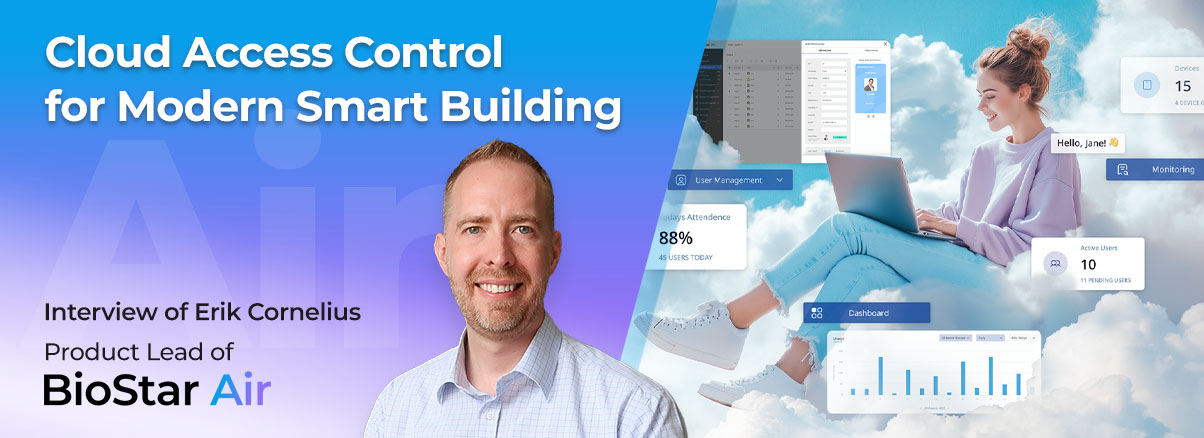
Suprema approaches the cloud model through the lens of simple implementation and redefined system architecture. Erik Cornelius, Product Lead of BioStar Air at Suprema Inc., notes that cloud is not just “putting software online” but a new concept in which the hardware itself becomes independent, without separate controllers. “We did not just move access control to the cloud—we removed the need for dedicated controllers. Each edge AI reader includes its own built‑in controller and connects directly to the cloud,” he explains. This approach enables installation without servers, rack cabinets, or local updates: the device connects to the network, is registered in the system, and is immediately ready to use. Suprema also integrates biometrics natively, so the cloud platform is not only a remote management tool but also the backend for accurate face and fingerprint identification.

While SALTO and Suprema emphasize flexibility, ease of use, and lower maintenance costs, Murat Türksoy, Head of Development at Primion Technology, highlights security—especially for European customers seeking full regulatory compliance: “Modern cloud services use end‑to‑end encryption, role‑based access control, multi‑factor authentication, and data storage in certified European data centers. This ensures full compliance with GDPR, ISO 27001, SOC 2, and national data protection regulations.” Türksoy adds that the combination of security, scalability, and automatic updates is particularly attractive for organizations with many sites, large user bases, and demanding audit requirements.


Why Users Move to the Cloud

The experts stress that the journey to cloud platforms is not linear. Motivations differ, but the destination is the same: a simpler, centralized, and more flexible access management system. The most common drivers, in addition to easier administration and lower costs, are the desire to bring multiple sites, users, and systems together on a single platform that does not require local server maintenance, backup routines, or IT support at every location.

“Companies want to manage all locations, doors, and users through one platform, without relying on local servers and IT teams. This saves time, reduces costs, and lowers the risk of errors,” says Türksoy, who argues that it is increasingly difficult to justify investments in local infrastructure when the cloud offers faster, more stable, and more secure options. Filipowicz confirms the same trend, noting that reduced IT workload is particularly appealing for small and mid‑sized businesses.

“There is no need for local servers, manual backups, or maintaining a security system. It is becoming harder and more expensive to keep the same security level on‑premises, which is why users are moving to the cloud.” At the same time, cloud adoption is not driven only by management efficiency—mobility and new user experience models also play a major role. Mobile credentials are becoming one of the key reasons for migration. “BioStar Air offers completely free, customizable mobile passes. Users can embed their access cards into their own apps—without extra costs and without installing a separate application. This is a huge advantage over traditional access cards,” says Cornelius.

Integration is another crucial dimension. Companies already using cloud‑based HR, ERP, video surveillance, or IoT platforms now want access control to become part of the same ecosystem. Cornelius explains that “cloud‑to‑cloud integration” is a key factor for customers who already have digital infrastructure and want a unified operational environment, while Türksoy notes growing demand for systems that incorporate AI‑driven monitoring and data insights. “Cloud platforms enable advanced analytics, insights into user behavior, space utilization, and security events. AI becomes something many organizations simply cannot achieve with local systems,” he says.


Which ACaaS Model is Most Attractive?

Cloud access control models may look similar from a user‑experience point of view, but technically they differ in how they balance local intelligence and centralized control. The experts describe three approaches: full‑cloud architecture, a hybrid model, and a portfolio approach that lets customers choose where they want the “center of gravity” of the system to be.

Suprema comes closest to a full‑cloud concept, since its BioStar Air platform is designed without servers, local controllers, or virtual machines to maintain. “Each reader contains its own controller and connects directly to the cloud. There are no local servers or controllers that need servicing,” stresses Cornelius, adding that this architecture can cut initial infrastructure costs by up to 50%.

By contrast, Primion Technology believes the hybrid model is more mature and secure, especially in environments where system uptime is critical and cannot depend solely on network connectivity. “Pure cloud solutions sound attractive but quickly hit limits when doors must continue to work reliably during internet outages. That’s why we use an architecture where on‑site controllers autonomously make key security decisions, while the cloud is responsible for administration, monitoring, and analytics,” explains Türksoy, noting that this combines the best of both worlds: offline resilience and online flexibility.

SALTO Systems takes a third path, offering multiple layers so that customers can choose fully on‑premises software, a pure cloud service, or a combined model. “Our portfolio includes ProAccess SPACE as an on‑premises platform, SALTO KS as a fully cloud‑based solution, and Homelok as a dedicated platform for residential properties. This allows us to support everything—from corporations to residential buildings—without limiting customers technologically,” explains Agnieszka Filipowicz.


Levels of Protection

Many potential users wonder whether the cloud can provide the same or higher level of data protection, privacy, and operational resilience, and what security mechanisms providers use to guarantee continuity of service even during internet outages. SALTO Systems emphasizes that security is built into its platform from the ground up rather than added later. “All data in transit is protected by TLS/SSL encryption, while data at rest is encrypted using AES‑256. With multi‑factor authentication and regular security testing, we ensure full compliance with GDPR and the NIS2 Directive,” says Filipowicz. SALTO uses redundant cloud infrastructure and local failover functions so that the system keeps operating even when the internet is temporarily unavailable. The company also holds BSI Kitemark certificates that confirm the security of IoT device components.

Suprema goes furthest in technical detail, treating data access as a cryptographic chain that must remain secure at every level—from the door reader to the cloud server. Communication occurs exclusively over HTTPS with TLS 1.2, data is encrypted with AES‑256, and mobile credentials are protected using PKI infrastructure,” explains Cornelius. Suprema does not rely on the cloud connection for door operation; each device includes its own local backup: “If the network goes down, the reader retains encrypted credentials and the doors continue to function. BioStar Air is designed to work even when the internet does not.”

Primion Technology offers a third perspective: security as an ongoing process rather than just a technical implementation. “We consistently apply security‑by‑design principles and maintain compliance with GDPR and NIS2, using TLS 1.2/1.3 encryption, digital certificates, and multi‑factor authentication,” says Türksoy. At Primion, key authentication decisions remain on the local controller, ensuring availability even in offline mode. The cloud is used for monitoring, configuration, and administration, while data is stored in redundant European data centers, preserving legal data sovereignty.


Key Development Trends

As access control increasingly moves into the cloud, the question is no longer whether transformation will happen, but what it will look like. Will mobile identities completely replace cards? Will biometrics become the default? What role will AI play, and will access control become just one component within a broader smart‑building ecosystem? These questions still need clear answers. The experts agree that the coming period will see system functionality extend beyond security toward analytics, integration, and business value.

SALTO Systems sees the future in combining several technologies that already exist but are only now entering mainstream use. “Mobile credentials are replacing physical cards, biometrics is becoming standard even in commercial buildings, and AI analytics makes it possible to model user behavior and predict system maintenance needs,” says Filipowicz. What used to be an “extra feature” is now a baseline expectation: mobile access, cloud administration, integration capabilities, and optimized user experience. At the same time, cybersecurity is no longer a separate topic but an integral part of technical security design.

According to Erik Cornelius of Suprema, the biggest change will come from integration with other platforms rather than from standalone technological upgrades. “Mobile ID and biometrics will continue to grow, but the real transformation happens when access control is tied into HR software, building management systems, and business processes. Access control becomes an operational tool, not just a security tool,” he says. Cornelius adds that AI will be used not only for event analytics but also for system management through natural‑language interaction: administrators will be able simply to tell the system, “Find all users added last week and grant them access to Meeting Room A on Tuesday.”

Primion Technology views the future through the lens of converged security and IoT integration. “Cloud access control is evolving from a management platform into an intelligent, connected security and service ecosystem,” says Türksoy, again stressing that technical and cybersecurity will no longer be separate domains. In his view, mobile identities, biometrics, and multi‑factor authentication will become standard, but the real breakthrough will come from how data is used.


The Future is Bright

Cloud solutions are opening a new chapter in security in which management stops being a technical burden and becomes a strategic advantage. Everything that once required kilometers of cabling, manual updates, and constant IT support is now available through a single platform—from mobile credentials and biometrics to centralized monitoring of multiple sites, AI‑driven analytics, and integration with other business systems. The experts indicate that the market has already moved beyond the evaluation phase and is now choosing between different models: full cloud, hybrid, or modular.

With growing demand for mobility, remote work, distributed operations, and lower IT costs, migrating to cloud‑based access control is no longer just a trend; it is a response to concrete operational needs. Organizations that adopt these platforms in time gain more than a security system—they gain the foundation for smarter, more efficient, data‑driven management of buildings and users.


Source:  asadria.com


Connect with industry leaders and join the conversation about this article by following us on LinkedIn, Facebook, and Instagram. Share your insights and expand your professional network.

This article is originally written in Bosnian by Nermin Kabahija(nermin.kabahija@asadria.com) and published in A&R Media.


お問い合わせフォーム

下記のフォームにご入力をお願いいたします。後日、担当者よりご連絡させていただきます。テクニカルサポートが必要な場合は、下記のボタンをクリックしてください。

テクニカルサポートchevron_right
メールアドレス *
氏名 *
*
社名 *
電話番号 *
送信

ありがとうございました。

お問い合わせは正常に送信されました。

近日中にご連絡させていただきます。

Your E-mail: partner@gmail.com