SUPREMA
- PRODUKTE
- Sicherheitsplattform
- BioStar X | On-Prem Sicherheit
- BioStar Air | Cloud-Sicherheit
- BioStar 2
- Zutrittskontrolle
- Zutrittskontrollgerät
- Biometrischer LeserNEW
- RFID-Leser
- Kabellose Türschlösser
- Peripheriegeräte
- Mobile Zugangskarte
- LÖSUNGEN


- Neuigkeiten
- Aktuelle Pressemitteilungen von Suprema
What Steve Jobs Taught Me About Building Better Security TechnologyJuly 31, 2026


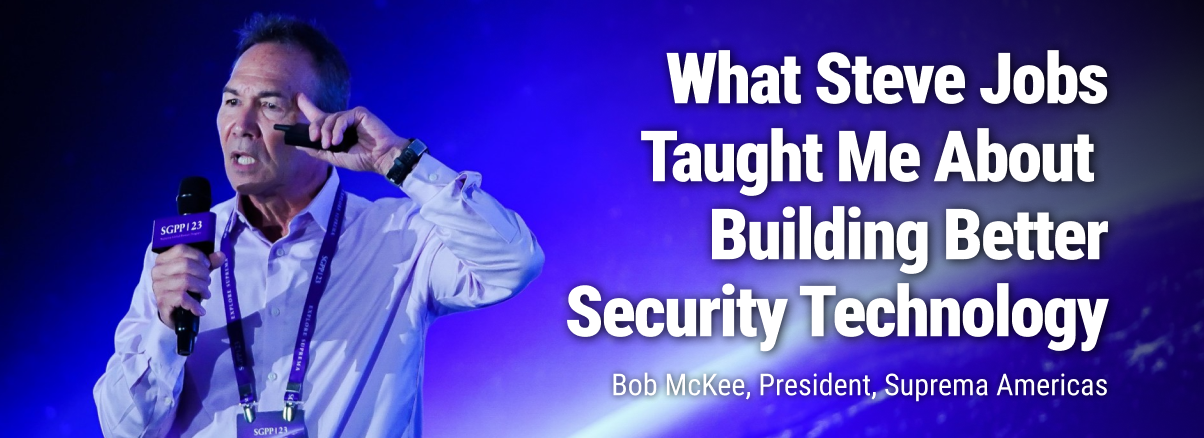
One of the best business lessons I learned didn’t come from business journals or the boardroom. It came from a biography: Steve Jobs by Walter Isaacson. If you haven’t read it, you should!
The book covers the full arc of Jobs’ career, and while many of the most talked about lessons center on his entrepreneurship, perfectionism, and brand building, the one that has stayed with me is his philosophy of design.
I don’t mean design in the sense of aesthetics, although Apple certainly became famous for that. I mean design as an understanding of how people interact with technology. Examples of Jobs’ design philosophy appear throughout the book, but the chapters about the birth of the iPod are particularly compelling.
If you’re too young to remember the era of downloading songs from Napster and loading them onto MP3 players, here’s the context. By the early 2000s, Apple was entering a crowded digital music player market. Companies like Sony, Creative and Rio had already introduced devices that were packed with technical innovation, and they were growing in popularity among college students, commuters, and early adopters who preferred the solid state devices over larger, glitchy portable CD players. Yet Jobs believed the entire MP3 player category possessed a fundamental flaw: all the products were too complicated.
Actually, Jobs used more blunt language. He said they all “were deeply flawed.” They held only a handful of songs, and users struggled with frustrating menu trees to access their most basic functions. As for the software managing the devices’ music libraries? To quote the book, “Only a genius could figure out half of their features.”
Jobs saw something the existing manufacturers didn’t. Their MP3 players weren’t offering the one thing that consumers wanted the most, an easier way to listen to music.
In envisioning the iPod, Jobs became obsessed with creating a more intuitive experience. He challenged his team to eliminate unnecessary complexity and established a simple rule for the user interface: if a person wanted a song or a function, they should be able to get there in no more than three clicks.
The result was a product that felt completely different to use. Apple took an incredibly sophisticated technology and made it approachable. The complexity didn’t disappear; it was just moved behind the curtain where the user didn’t have to think about it. Despite being a late entrant to the MP3 industry, Apple quickly became the dominant manufacturer in the category because of the iPod’s unmatched usability.
Plenty of successful companies cared about usability, but Jobs made simplicity a strategic priority. While competitors were adding features and complexity, Apple was asking, “How do we make this easier?” Twenty years later, I still think that’s one of the most important questions any technology company can ask, and one that is shaping the next generation of security technology.
Which brings me to where I spend most of my time these days: Identity verification.
For years, the security industry viewed convenience and security as competing priorities. Making a system more secure meant adding steps, procedures, and user responsibilities. What’s exciting about modern biometrics is that we’re increasingly able to improve both simultaneously. In many ways, we’re applying Jobs’ three click philosophy to identity verification, reducing the interaction required from the user without compromising the strength of the underlying security. And by reducing friction, organizations can implement more frequent identity verification that supports stronger security practices.
The simplicity of the biometric authentication experience can make people underestimate the sophistication of the technology behind it. Just as iPod users didn’t have to think about file formats, manually transferring songs to their device, or navigating cumbersome menus, users of modern biometric systems don’t have to think about how their faces, palms, or fingerprints are converted into encrypted, mathematical templates that cannot be reverse engineered. Or how the system verifies that a live person, not a photo, is standing in front of it. Or how AI quietly adjusts for the naturally occurring, gradual changes in a person’s appearance, whether from age, lifestyle, or a few extra pounds.
Interacting with a biometric identity solution is like listening to music on an iPod or today, an iPhone. You don’t even think about the incredible technology working in the background that makes the experience possible. For example, with facial authentication, the most frictionless form of identity verification, you look at a reader without even stopping. In a fraction of a second, the system accurately matches you to your digital identity with a false match rate as low as 1 in 10 billion! I consider that more like a ‘zero click’ solution.
As our industry embraces AI, we can expect to see a new generation of products that can automate more tasks, synthesize more data, and deliver more functionality than ever before. The challenge for manufacturers will be resisting the temptation to make them more complicated.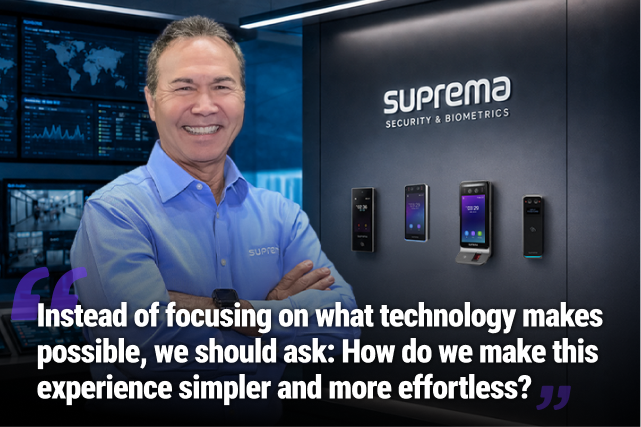
Product teams should take a page from Jobs’ playbook. Instead of focusing on what the latest technology makes possible, they should be asking,
“What do our customers genuinely want? And how can we use technology to make that experience better? Easier? Simpler? As effortless as using your face to access your phone?”
That’s the lesson of the iPod, and why a guy who never developed a security product has provided one of the most important lessons for our industry. Companies that build products people want to use will also be creating solutions that are adopted more broadly, used more consistently, and ultimately provide better protection.



Vielen Dank.
Ihre Anfrage wurde erfolgreich gesendet.
Wir werden uns in Kürze bei Ihnen melden.
Ihre E-Mail-Adresse: partner@gmail.com